Encinitas, CA, Feb. 26, 2026 (GLOBE NEWSWIRE) -- Disclaimer: This article is for informational purposes only. It is not medical advice. Anti-aging, cellular health, and longevity concerns should be evaluated by a qualified healthcare professional. Compounded NAD+ is a prescription medication that requires evaluation by a licensed clinician. Prescription approval is not guaranteed. If you purchase through links in this article, a commission may be earned at no additional cost to you.
As consumer interest in NAD+ therapy and anti-aging telehealth programs continues to accelerate in 2026, individuals researching injectable nicotinamide adenine dinucleotide (NAD+) options are navigating a category with expanding access models and distinct regulatory considerations. One platform that appears frequently in that research process is Sprout Health NAD+ — a telehealth service operated by Sprout Health Partners LLC that connects consumers with licensed clinicians and partner compounding pharmacies for potential access to compounded NAD+ injections.
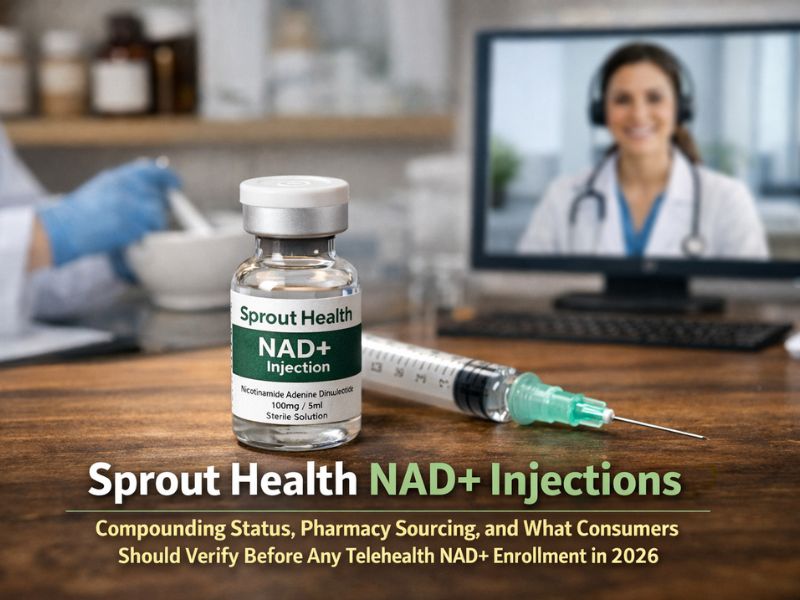
Before discussing enrollment in any compounded NAD+ telehealth program with a clinician, there are regulatory, clinical, and platform-level details that are worth understanding clearly. This article walks through those details — not as a recommendation, but as the kind of informed verification framework that helps someone ask the right questions and confirm the right information before making a decision that directly involves their health.
A previously released regulatory and verification briefing examining Sprout Health's compounded GLP-1 telehealth model provided a detailed framework for evaluating the platform's weight loss program, FDA classification, and consumer due-diligence considerations. This article applies a similar verification framework to the company's NAD+ anti-aging program specifically.
Consumers can review the company's disclosures directly and view the current Sprout Health NAD+ program details (official Sprout Health page) for the most up-to-date information.
What This Product Is: Regulatory Classification First
This is the single most important starting point — and it warrants careful reading regardless of which compounded NAD+ product or telehealth platform someone may be evaluating.
Sprout Health NAD+ is a telehealth platform — not a healthcare provider, pharmacy, or drug manufacturer — that connects consumers with independent licensed clinicians and partner compounding pharmacies for potential access to compounded NAD+ injections. The company describes its program as supporting cellular health, energy, and recovery. Compounded NAD+ is a prescription medication, and prescription approval is not guaranteed.
Based on publicly available disclosures on the company's website, Sprout Health Partners LLC operates the technology platform at joinsprouthealth.com. The platform provides the intake process, customer support, subscription management, and coordination between patients, providers, and pharmacies. The platform itself does not prescribe medications or make clinical decisions.
Here is the key classification distinction that matters most: compounded NAD+ injections are not FDA-approved finished products. They have not been reviewed by the FDA for safety, effectiveness, or quality as finished formulations. Compounded NAD+ is not equivalent to an FDA-approved drug product. Compounded medications are prepared by pharmacies based on individual prescriptions issued by licensed healthcare providers.
Regulatory Framework: What Compounded NAD+ Means Under FDA Guidelines
Pharmacy compounding is the practice of creating customized medications tailored to individual patient needs. Compounding pharmacies operate under federal and state regulations, and the practice is overseen by state pharmacy boards. Compounded medications are legally prescribed and dispensed in the United States when prepared by licensed pharmacies under the direction of a licensed prescriber.
The regulatory distinction from FDA-approved drugs is specific. FDA-approved medications undergo clinical trials evaluating the finished product's safety and efficacy as a complete formulation. Compounded medications use active pharmaceutical ingredients but are not required to undergo separate clinical trials for the specific compounded version.
According to the company's website, Sprout Health's NAD+ injections are compounded in the United States by state-licensed pharmacies that follow FDA compounding guidelines. The company states that each batch is third-party tested in FDA- and DEA-registered labs. These statements are attributable to the company and have not been independently verified by the publisher of this article.
NAD+ as a therapeutic substance occupies a distinct regulatory position. Unlike compounded GLP-1 medications — which reference FDA-approved branded counterparts such as Ozempic and Wegovy — there is no widely marketed FDA-approved NAD+ injection product serving as a direct branded equivalent. This means the compounding framework for NAD+ operates under different market conditions than categories where FDA-approved alternatives are commercially available.
How the Telehealth Structure Works: Platform, Clinician, and Pharmacy
One of the most common points of confusion with telehealth prescription services — and one that really matters when someone is evaluating a platform for the first time — is understanding who actually does what. With Sprout Health, and with most telehealth prescription platforms, there are three separate entities involved. Knowing the distinction between them is more important than most people initially realize.
Sprout Health Partners LLC operates as the telehealth platform. According to the company's terms of use, Sprout Health itself is not a healthcare provider. The platform provides the technology infrastructure, customer service, subscription management, and coordination that facilitates the telehealth experience. Sprout Health does not diagnose conditions, write prescriptions, or make clinical treatment decisions.
Licensed Medical Providers are independent healthcare professionals who review patient-submitted medical information and independently determine whether a prescription is clinically appropriate. The company states that these clinicians operate through MD Integrations (MDI), a physician network. In certain states, synchronous telehealth visits are required by state law. The platform cannot guarantee that any individual will receive a prescription — that determination rests entirely with the evaluating clinician.
Licensed Partner Pharmacies compound and dispense medications based on prescriptions written by the independent medical providers. According to the company's terms and conditions, Sprout Health partners with Foothills Pharmacy and Promise Pharmacy. Some third-party sources report LegitScript certification for the platform; consumers can verify current certification status directly at legitscript.com/directory, which is LegitScript's own public verification tool.
This three-entity structure — platform, prescriber, pharmacy — is standard across telehealth prescription services. It exists to maintain appropriate separation between technology facilitation, clinical judgment, and pharmaceutical dispensing.
What It Contains: NAD+ Formulation and Delivery Method
According to the company's website, Sprout Health's NAD+ program provides access to compounded NAD+ (nicotinamide adenine dinucleotide) injections delivered via subcutaneous injection — administered just under the skin, not into muscle or veins. Compounded NAD+ is a prescription medication. Prescription approval is not guaranteed.
The company states that each vial contains 1000 mg of sterile, preservative-free compounded NAD+, prepared in U.S. state-licensed compounding pharmacies. The platform describes the formulation as pharmacy-grade and third-party lab-tested. These characterizations are attributable to the company.
NAD+ is a coenzyme naturally found in every cell of the body. According to publicly available scientific literature, NAD+ plays a central role in cellular processes including mitochondrial energy production (ATP synthesis), DNA repair, gene expression regulation, and cell signaling. Research published in peer-reviewed journals has documented that NAD+ levels decline with age and in response to various metabolic stressors.
Important evidence boundary: While ingredient-level research on NAD+ as a molecule is published in scientific literature, these findings describe the biological role of NAD+ at the cellular and molecular level. They do not constitute clinical evidence that any specific compounded NAD+ injection product will produce particular health outcomes in individual consumers. The distinction between ingredient-level research and product-level clinical evidence is significant and should inform consumer expectations.
Delivery, Usage, and Program Structure
According to the company's website, the NAD+ program follows a structured telehealth access model. The process begins with a free online consultation where a licensed provider reviews the consumer's health information and determines whether NAD+ therapy is clinically appropriate. If a prescription is issued, a compounded NAD+ kit is shipped directly to the consumer.
If prescribed, the company states the medication is intended for at-home subcutaneous administration, with detailed instructions provided by the dispensing pharmacy and prescribing clinician. A complete home injection kit is included with the supplies needed to begin treatment. Consumers with questions about administration technique should consult their prescribing provider directly.
According to the company's dosing guidance, prescribing providers determine the appropriate dosage and schedule. The company states that the recommended dosage is two injections per week at 1000 mg per vial. Consumers should follow their prescribing provider's exact instructions regarding dosing frequency and amount.
The company states that orders are typically delivered within three to seven business days after prescription approval and processing. Monthly subscribers complete a refill medical questionnaire to allow the assigned clinician to evaluate progress and assess any potential side effects before issuing a subsequent prescription. Dosage adjustments are determined by the licensed clinician based on clinical assessment.
Individual responses to NAD+ therapy may vary depending on factors including age, baseline NAD+ levels, overall health status, lifestyle factors, adherence to the prescribed treatment plan, and individual metabolic response. No specific outcome is guaranteed.
Pricing Disclosures
Pricing and subscription structure are material consumer-disclosure points in telehealth programs and should be reviewed carefully before initiating any discussion with a clinician.
According to the company's posted pricing at the time of this article, the NAD+ program is listed at $149 for the first month, with standard pricing of $240 per month on auto-renewal every four weeks thereafter. The company identifies this as the recommended dosage of two injections per week at the 1000 mg vial size. Pricing is subject to change; consumers should verify current pricing directly on the official website before beginning any treatment discussions. Compounded NAD+ is a prescription medication. Prescription approval is not guaranteed. Compounded medications are not FDA-approved finished products.
According to the company, each subscription includes a free initial consultation, compounded NAD+ medication, a complete home injection kit, free shipping, ongoing doctor access, and dedicated support. The company states that if a consumer is determined to be ineligible for NAD+ therapy during the initial consultation, no charge is incurred.
Sprout Health operates on a subscription basis that auto-renews every four weeks. The company does not accept or bill insurance for NAD+ therapy and accepts major debit and credit cards.
According to the company's refund policy, prescription medications are non-refundable once processed by the partner pharmacy. Consumers are encouraged to review the complete terms and conditions before purchase.
Safety, Risks, and Limitations
While NAD+ is a naturally occurring coenzyme in the body, compounded injectable NAD+ therapy carries considerations that anyone thinking about this category should discuss with a qualified healthcare provider before getting started.
Potential side effects associated with injectable NAD+ may include injection site reactions such as redness, swelling, or discomfort. Some individuals may experience nausea, headache, fatigue, or flushing following administration. More information about individual risk factors should be obtained from the prescribing clinician.
Compounded medication-specific considerations include potential variability in formulation between batches, the importance of proper self-administration technique, and the need for appropriate storage conditions. The company states that vials should be kept refrigerated and stored away from children or pets.
Telehealth limitations also apply to this model. A telehealth evaluation may not capture all relevant clinical information that would be available in an in-person examination. Consumers with complex medical histories, multiple medications, or significant comorbidities should discuss NAD+ therapy with their primary care provider or specialist in addition to any telehealth evaluation.
Compounded NAD+ injections are not FDA-approved finished products and have not been reviewed by the FDA for safety, effectiveness, or quality as finished formulations. Any decision to prescribe, dose, or continue therapy is made by the licensed clinician based on the patient's medical profile.
According to the company's website, NAD+ therapy is not available to consumers in Arkansas, Kansas, or New Mexico due to state-specific restrictions. Additional state restrictions may apply. Consumers should verify current eligibility directly with the platform.
What Consumers Commonly Verify
For anyone doing their homework on a telehealth platform — especially one that involves compounded prescription medications — there are a handful of verification categories that tend to come up consistently. None of these replace professional medical advice, but they represent the kind of due-diligence steps that informed consumers typically take.
Business registration and entity verification: Consumers often verify whether the operating entity is registered and identifiable. According to the company's terms and conditions, Sprout Health Partners LLC is the registered business entity, with Michigan identified as the governing law jurisdiction.
Clinician licensing and oversight: Consumers often verify whether prescribing clinicians are independently licensed. The company states that providers operate through the MD Integrations (MDI) physician network. Individual provider credentials can be verified through the relevant state medical board. Availability and licensing status can change; verification should be done through the issuing state licensing authority.
Pharmacy licensing and certification: Consumers often verify whether compounding pharmacies are state-licensed and hold third-party certifications. The company identifies Foothills Pharmacy and Promise Pharmacy as partners. Certification status can change; verification should be done through the issuing organization directly.
Third-party testing claims: The company states that each batch is third-party tested in FDA- and DEA-registered labs. Consumers may request specific certificate of analysis documentation from the dispensing pharmacy to independently confirm testing claims.
Terms, refund policies, and subscription structure: The company's refund policy states that prescription medications are non-refundable once processed by the partner pharmacy. Consumers are encouraged to review the complete terms and conditions — including auto-renewal, cancellation, and refund provisions — before purchase.
How This Category Compares to Other NAD+ Access Models
Anyone exploring NAD+ therapy in 2026 will quickly discover that there are several different ways to access it — and each model comes with a different set of trade-offs in terms of regulatory status, cost, convenience, and clinical oversight. Understanding those differences makes it much easier to evaluate any individual platform in context.
IV NAD+ infusion clinics: In-person clinics administering NAD+ intravenously under direct clinical supervision. These typically involve higher per-session costs and require in-person attendance, but provide direct medical oversight during administration. IV delivery is a different administration route than subcutaneous injection.
Compounded NAD+ through telehealth platforms: Platforms facilitating access to compounded NAD+ injections prepared by licensed compounding pharmacies for at-home self-administration. This model may be perceived as more convenient for some consumers because it can involve at-home administration following a clinician evaluation; however, costs, oversight, and suitability vary widely by provider, pharmacy, dosage, and individual medical profile.
Oral NAD+ precursor supplements: Over-the-counter supplements containing NAD+ precursors such as nicotinamide riboside (NR) or nicotinamide mononucleotide (NMN), available without a prescription. These are dietary supplements regulated differently than compounded injectable products. According to publicly available research, oral bioavailability of NAD+ precursors differs from injectable delivery methods.
No specific platform or model is presented as superior. Each carries distinct trade-offs in cost, convenience, regulatory status, bioavailability, and level of clinical oversight.
What Regulators Mean by Compounding vs FDA Approval
This distinction comes up in virtually every conversation about compounded medications, and it is worth understanding clearly — not just for NAD+, but for any compounded prescription product accessed through a telehealth platform.
When the FDA approves a medication, that approval covers the complete finished product: the active ingredient, the inactive ingredients, the manufacturing process, the quality controls, and the specific labeling. The manufacturer submits clinical trial data demonstrating that the finished product is safe and effective for its intended use. The FDA then monitors the approved product through ongoing surveillance, adverse event reporting, and periodic facility inspections.
Compounded medications follow a different pathway. Under Section 503A of the Federal Food, Drug, and Cosmetic Act, licensed pharmacies may compound medications to fill individual prescriptions for patients whose needs cannot be met by commercially available FDA-approved products. Compounding pharmacies are regulated by state pharmacy boards and must comply with applicable federal guidelines, but compounded medications themselves are not independently reviewed by the FDA for safety, effectiveness, or quality as finished formulations.
This does not mean compounded medications are unregulated or inherently unsafe. It means they occupy a different regulatory category with different oversight mechanisms. Consumers evaluating any compounded medication — whether NAD+, GLP-1, hormone therapy, or other categories — should understand that the evidence base, quality assurance processes, and regulatory oversight differ meaningfully from FDA-approved products. A licensed healthcare provider is the appropriate resource for evaluating whether a compounded medication is clinically appropriate for an individual patient.
Questions To Ask Any NAD+ Telehealth Platform
Regardless of which NAD+ telehealth platform someone is evaluating, there are several questions that informed consumers commonly ask before committing to a subscription. These questions are not specific to any single company — they apply broadly to the category.
About the prescribing process: Who is the licensed clinician reviewing the medical intake? Are they independently licensed in the consumer's state? Is the evaluation synchronous (live consultation) or asynchronous (questionnaire review)? What happens if the clinician determines that NAD+ therapy is not appropriate — is there a charge?
About the compounding pharmacy: Which pharmacy compounds the medication? Is the pharmacy state-licensed and operating under Section 503A or 503B of the FD&C Act? This varies by pharmacy and should be confirmed directly with the dispensing entity. Does the pharmacy hold any third-party certifications such as PCAB accreditation or LegitScript verification? Can the consumer request a certificate of analysis for their specific batch?
About the medication itself: What is the concentration and volume per vial? What are the inactive ingredients (excipients) in the formulation? Is the formulation preservative-free? What are the storage requirements, and how is temperature controlled during shipping?
About the subscription and financial terms: What is the auto-renewal cadence? What is the cancellation process? What is the refund policy if the prescription is not approved, or if medication has already been shipped? Are there price-lock guarantees, or can pricing change between renewal cycles?
About ongoing clinical oversight: How are dosage adjustments handled? Is there a medical questionnaire required before each refill? Can the consumer message their clinician directly between refill cycles? What should a consumer do if they experience side effects?
These questions are designed to help consumers conduct independent verification regardless of which platform they are considering. The answers should come directly from the platform, the prescribing clinician, and the dispensing pharmacy — not from marketing materials alone.
Evidence Boundaries
Consumers should understand the distinction between molecular-level research on NAD+ and product-level clinical evidence when evaluating any compounded NAD+ program. This distinction is not always made clear in marketing materials, which is exactly why it belongs in an independent verification framework like this one.
Molecular and preclinical evidence exists for the biological role of NAD+ in cellular function. Research published in peer-reviewed journals has documented the involvement of NAD+ in mitochondrial energy production, DNA repair through sirtuin and PARP enzyme pathways, and cellular signaling processes. Studies have also documented the age-related decline of NAD+ levels in human tissues.
Limited clinical trial evidence exists specifically evaluating injectable compounded NAD+ products in human subjects. While some clinical studies have examined NAD+ precursors (such as NR and NMN) and their effects on NAD+ bioavailability in humans, large-scale randomized controlled trials specifically evaluating the safety, efficacy, and optimal dosing of compounded injectable NAD+ for anti-aging or wellness outcomes remain limited in the published literature as of early 2026.
Product-level evidence does not exist for any specific compounded NAD+ injection product as prepared by compounding pharmacies. The biological research on NAD+ as a molecule should not be interpreted as clinical evidence that a specific compounded product will produce particular health outcomes.
Summary of Key Considerations
Sprout Health NAD+ operates as a telehealth platform connecting consumers with licensed clinicians and partner compounding pharmacies for potential access to compounded NAD+ injections. The platform is operated by Sprout Health Partners LLC.
Key considerations include the non-FDA-approved status of compounded NAD+ injections as finished products, the distinction between molecular research on NAD+ and the limited product-level clinical trial data available for compounded injectable formulations, the platform's posted pricing of $149 for the first month with $240 per month on auto-renewal, and the self-administration model requiring consumers to perform subcutaneous injections at home. Prescription approval is not guaranteed. Compounded medications are not FDA-approved finished products.
Consumers interested in reviewing the platform's current terms can view the current Sprout Health NAD+ program details (official Sprout Health page) for the latest program and pricing information.
Contact Information
For questions about Sprout Health NAD+, according to the company's website:
Sprout Health Partners LLC
Website: https://joinsprouthealth.com
Email: help@joinsprouthealth.com
Phone: +1 (833) 496-4020
Hours: According to the company, support is available Monday through Friday, 9:00 a.m. to 5:30 p.m. Mountain Time.
Disclaimers
General Disclaimer: This article is for informational purposes only and does not constitute medical, financial, or professional advice. Individuals should consult a qualified healthcare provider before starting, stopping, or modifying any prescription medication regimen. If you purchase through links in this article, a commission may be earned at no additional cost to you.
Compounded Medication Notice: Compounded NAD+ injections are not FDA-approved finished products. They have not been reviewed by the FDA for safety, effectiveness, or quality as finished formulations. Compounded drugs are prepared by pharmacies based on individual prescriptions and are not generic equivalents of any FDA-approved branded medication. Compounded medications should only be used when determined clinically appropriate by a licensed healthcare provider.
Evidence Disclaimer: Scientific research cited in this article refers to published studies examining the biological role of NAD+ at the molecular and cellular level. These findings do not constitute clinical evidence that any specific compounded NAD+ injection product will produce particular health outcomes in individual consumers. Large-scale randomized controlled trials specifically evaluating compounded injectable NAD+ for anti-aging or wellness outcomes remain limited in published literature.
Results Disclaimer: Individual results may vary. Responses to NAD+ therapy depend on numerous factors including age, baseline NAD+ levels, overall health status, adherence to prescribed treatment, lifestyle factors, and individual metabolic response. No specific outcome is guaranteed.

Email: help@joinsprouthealth.com Phone: +1 (833) 496-4020